

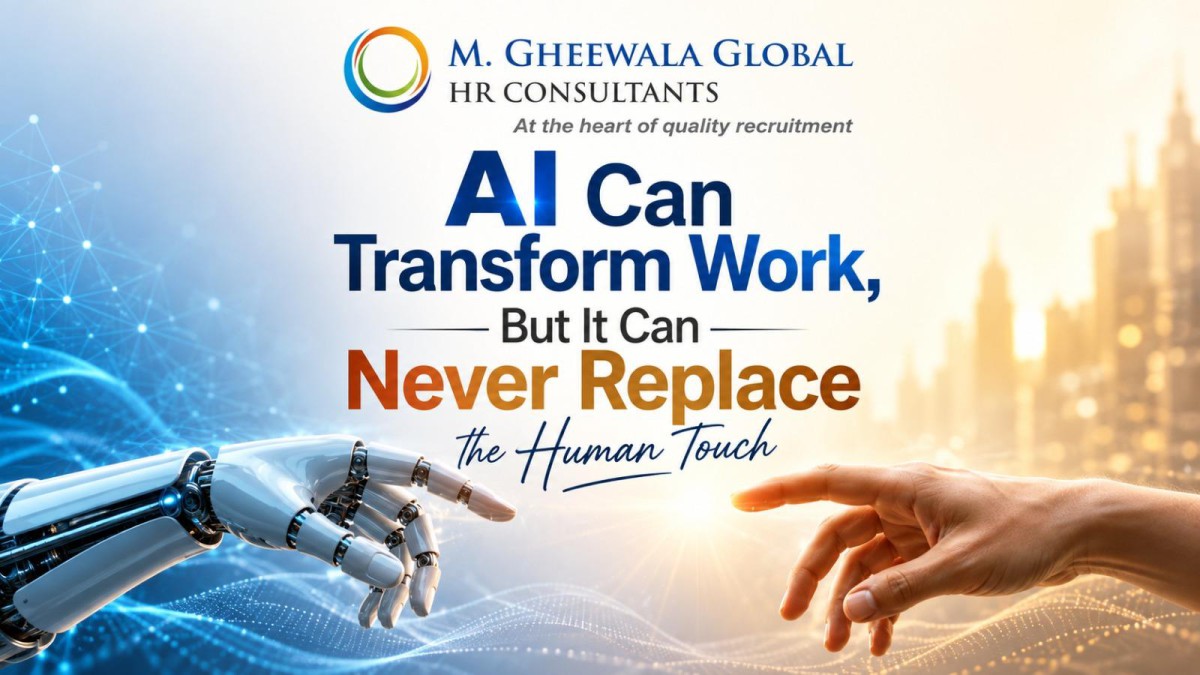
AI Can Transform Work, But It Can Never Replace the Human Touch
Artificial intelligence has become one of the biggest drivers of workplace transformation in recent years. From automating repetitive tasks to analyzing massive amounts of data within seconds, AI is helping organizations become faster, smarter, and more efficient than ever before. Across industries such as healthcare, recruitment, hospitality, education, retail, and manufacturing, businesses are adopting AI to improve productivity and streamline operations.
However, while AI transforms the human touch by improving efficiency and decision-making, one truth remains unchanged: AI can never replace the human touch. Technology can generate content, automate workflows, and predict trends, but it cannot genuinely understand emotions, build meaningful relationships, or make ethical decisions based on empathy and lived experience.
The future of work and human skills: AI is not about replacing people with machines. Instead, it is about creating a workplace where AI supports human expertise, while people continue to lead with creativity, emotional intelligence, judgement, and compassion.
AI Is Changing How We Work, Not Why Human Skills Matter
The workplace has evolved rapidly because of AI-powered tools. Businesses now use AI for customer support, content creation, recruitment screening, predictive analytics, workflow automation, and decision support. These innovations reduce manual effort and allow employees to focus on higher-value responsibilities.
This shift demonstrates that AI is changing how we work, not what makes work meaningful. AI handles repetitive and data-intensive tasks exceptionally well, but it still relies on AI tools, human oversight for accuracy, fairness, and accountability. Human professionals provide context, evaluate outcomes, and ensure technology aligns with organizational values and customer expectations.
Rather than replacing employees, AI is creating a smart workplace environment where technology enhances productivity while people remain at the center of decision-making.
Why AI Can Never Replace Human Touch
Despite its growing capabilities, AI lacks the qualities that define human interaction. It cannot experience empathy, understand emotional complexity, or build authentic trust. These qualities are essential in workplaces where relationships, collaboration, and ethical decisions matter.
AI can never replace human touch because humans communicate through emotions, intuition, and shared experiences. Whether comforting a patient, mentoring a colleague, resolving a customer complaint, or leading a team during uncertainty, people rely on emotional understanding that AI simply cannot replicate.
Organizations embracing AI innovation and human values recognize that technology should strengthen human capabilities rather than eliminate them. The most successful companies use AI to improve efficiency while preserving the human experiences customers and employees value most.
Emotional Intelligence Will Define Success in the AI Era
One of the most valuable workplace skills today is emotional intelligence in the AI era. As automation becomes more common, the ability to understand emotions, communicate effectively, and build trust becomes increasingly important.
Emotional intelligence helps professionals navigate difficult conversations, resolve conflicts, motivate teams, and create positive customer experiences. AI may identify customer behavior patterns, but only humans can recognize emotional cues and respond with empathy and care.
Industries that depend heavily on relationships, including healthcare, recruitment, hospitality, education, and customer service, continue to rely on emotional intelligence as a competitive advantage. As AI adoption grows, professionals with strong interpersonal skills become even more valuable.
Critical Thinking and Human Judgment Still Matter
AI is capable of generating recommendations and analyzing historical data, but it cannot independently determine the best course of action in every situation. This is where critical thinking in the AI workplace becomes essential.
Employees must evaluate AI-generated insights, question assumptions, identify potential risks, and make decisions that balance business goals with ethical considerations. Human judgment remains indispensable when situations involve uncertainty, conflicting priorities, or social and cultural context.
The importance of human judgment in AI decisions is especially visible in hiring, healthcare, finance, law, and leadership, where decisions affect people's lives and require accountability beyond algorithms.
AI Assists Employees, It Doesn't Replace Them
A growing number of organizations are adopting the philosophy of AI assist, not replacement, for employees. Instead of viewing AI as a replacement for workers, businesses increasingly use it as a productivity partner.
AI can summarize meetings, automate administrative work, generate first drafts of content, analyze customer behavior, and support research. These capabilities save time, allowing professionals to focus on creativity, strategy, communication, and relationship building.
This collaborative approach reflects the principle of working with AI, not against AI. Employees who understand how to use AI effectively become more productive while maintaining ownership of quality, ethics, and final decision-making.
Human in the Loop AI Creates Better Decisions
The concept of human in the loop AI has become a best practice for responsible AI adoption. In this model, AI generates recommendations or performs tasks, but humans review, validate, and approve outcomes before action is taken.
Human oversight improves accuracy, reduces bias, and ensures accountability in AI-driven processes. Whether reviewing AI-generated recruitment recommendations, approving financial transactions, or validating healthcare insights, human involvement creates safer and more reliable systems.
This partnership demonstrates how AI supports human expertise instead of replacing professional knowledge and experience.
Industry Examples Where Human Touch Creates Real Value
Healthcare AI Needs Human Caregivers
Healthcare has benefited tremendously from AI through faster diagnostics, predictive analytics, and medical imaging support. Yet Healthcare AI human caregivers remain irreplaceable because patients need empathy, reassurance, and compassionate communication throughout their treatment journey. AI can assist doctors with information, but caregivers provide the emotional support that improves patient outcomes.
Education Still Needs Human Teachers
AI-powered learning platforms personalize education and automate assessments, but Education AI human teachers continue to inspire curiosity, mentor students, and adapt learning based on emotional and social needs. Great teaching involves encouragement, motivation, and human connection beyond technology.
Hospitality Is Built on Human Service
Hotels and restaurants increasingly use AI for bookings, recommendations, and operational efficiency. However, Hospitality AI and human service are what create memorable guest experiences. Personalized greetings, thoughtful problem-solving, and genuine hospitality build customer loyalty in ways automation cannot.
Retail Depends on Human Connection
Retail businesses use AI to recommend products and optimize inventory, but retail AI human connection remains essential for understanding customer preferences, offering personalized advice, and creating positive shopping experiences that encourage repeat business.
Manufacturing Needs Skilled Workers
Automation has transformed manufacturing processes, yet Manufacturing AI skilled workers continue to manage equipment, solve unexpected production issues, maintain quality standards, and ensure workplace safety. Human expertise remains critical for complex operational decisions.
Customer Service Requires Human Agents
Chatbots are excellent for answering frequently asked questions, but Customer service human agents are essential for handling emotional situations, resolving complaints, negotiating solutions, and building long-term customer relationships through empathy and communication.
AI-Proof Careers in 2026: Which Jobs AI Won't Take
As AI becomes more capable, many professionals ask whether their careers are at risk. While automation will change many tasks, the strongest Jobs safe from AI in 2026 are those requiring human interaction, creativity, leadership, and emotional intelligence.
Many AI proof careers involve responsibilities that depend on empathy, ethical judgment, collaboration, and complex decision-making. Healthcare professionals, teachers, counselors, hospitality experts, recruiters, leaders, skilled tradespeople, and customer relationship specialists continue to provide value that AI cannot fully replicate.
The best future proof jobs combine technical knowledge with communication, adaptability, creativity, and emotional intelligence. Instead of avoiding AI, professionals should learn how to work alongside it while strengthening uniquely human capabilities.
AI Literacy and Human Skills Must Grow Together
The future workplace requires more than technical knowledge. Employees need both AI literacy and strong interpersonal skills to remain competitive.
Understanding how AI works helps professionals use technology responsibly and effectively. At the same time, communication, collaboration, creativity, adaptability, and ethical thinking ensure people continue to provide value where machines cannot.
This balance between AI literacy and human skills creates professionals who are prepared for continuous technological change while maintaining a human-centered approach to work.
Organizations investing in human centered AI design focus on building technology that supports employees, improves customer experiences, and reflects human values instead of simply maximizing automation.
The Future of Work Is Human Orchestration
The next phase of workplace transformation is not about humans versus AI. It is about humans orchestrating AI to achieve better outcomes.
Future of work human orchestration means employees define goals, interpret AI insights, make strategic decisions, and ensure technology aligns with business objectives and customer needs. AI becomes an intelligent assistant, while humans remain responsible for leadership, ethics, creativity, and innovation.
As businesses continue adopting automation, success will depend on automation human worker partnership, where technology handles repetitive work and people focus on solving meaningful problems and creating lasting relationships.
Adapting to Technological Change Without Losing Human Values
Every major technological advancement has changed the way people work, and AI is no exception. The key to long-term career growth is embracing technological change, human adaptation, continuous learning and skill development.
Professionals who invest in emotional intelligence, leadership, communication, creativity, and AI literacy will be better prepared for the future workplace. Companies that combine AI innovation with human values will build stronger teams, deliver better customer experiences, and create sustainable growth.
The future belongs to organizations that understand AI is a tool for empowering people, not replacing them.
Conclusion
Artificial Intelligence is transforming workplaces across every industry, improving efficiency, productivity, and decision-making. Yet the qualities that make us human – empathy, creativity, ethical judgment, communication, leadership, and emotional intelligence – remain impossible to automate.
AI transforms work, but the human touch remains at the heart of every successful workplace. It cannot replace the trust, compassion, and meaningful relationships that drive great teams and exceptional customer experiences. The future of work is built on collaboration, where AI supports human expertise and people use technology to make smarter, more impactful decisions.
At M. Gheewala Global HR Consultants, we believe technology is a powerful enabler, but people will always be the foundation of successful recruitment and workforce solutions. By combining AI-driven innovation with decades of human expertise, we help organizations hire smarter while keeping empathy, fairness, and human judgment at the center of every hiring decision.
The future is not about choosing between AI and humans; it's about creating workplaces where AI empowers people, and the human touch continues to make the difference.
FAQs
What skills AI cannot replace?
AI cannot replace emotional intelligence, empathy, creativity, ethical judgment, leadership, communication, and critical thinking because these skills require human understanding and experience.
Which jobs are AI proof?
Healthcare professionals, teachers, counselors, hospitality professionals, recruiters, skilled tradespeople, customer relationship managers, and leadership roles are among the most AI-proof careers.
Should companies replace workers with AI?
No. AI should automate repetitive tasks while employees continue handling strategy, creativity, customer relationships, and decision-making with human oversight.
Do employees trust AI?
Employees are more likely to trust AI when organizations provide transparency, training, and keep humans involved in important decisions through human in the loop AI practices.
Do customers want AI or human service?
Customers appreciate AI for speed and convenience, but they still prefer human service for personalized advice, emotional conversations, complaints, and complex problem-solving.
What jobs will AI never take?
Jobs centered around caregiving, teaching, counseling, leadership, relationship management, hospitality, and creative strategy will continue requiring a strong human touch.
Why can't AI replace humans?
AI processes data and recognizes patterns, but it cannot genuinely experience empathy, emotions, intuition, moral reasoning, or human relationships.
Am I going to lose my job to AI?
AI is more likely to change tasks than eliminate every role. Developing AI literacy alongside human skills makes professionals more valuable in the future workplace.
Are young workers more at risk from AI?
Entry-level roles with repetitive tasks are more exposed to automation, making continuous upskilling and human-centered skills increasingly important.
Is AI good or bad for workers?
AI is most beneficial when it enhances productivity, reduces repetitive work, and supports human expertise while keeping people at the center of workplace decisions.
Follow M. Gheewala Global HR Consultants for Latest Vacancies